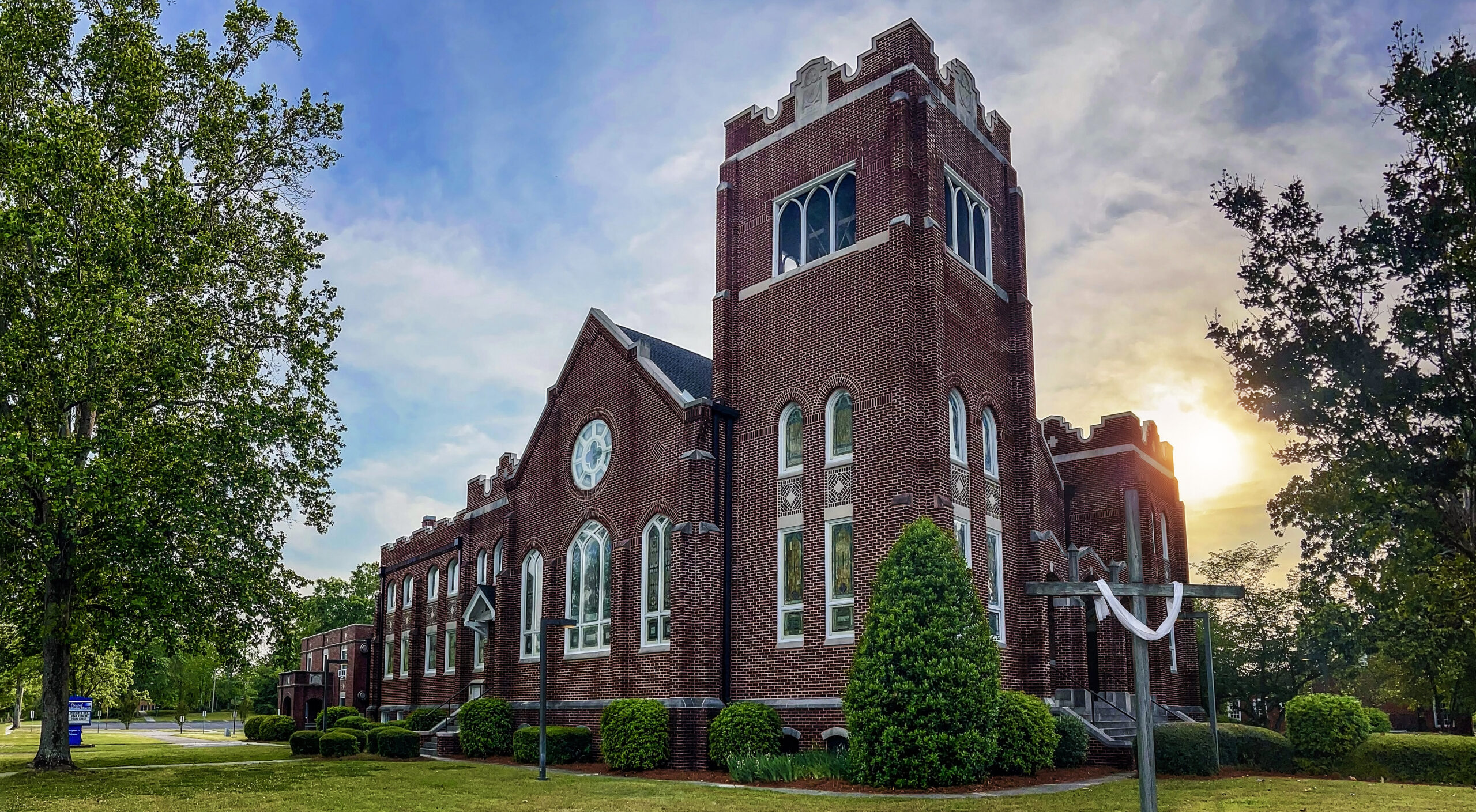
About First United Methodist Church of Laurinburg
United Methodist Beliefs
First United Methodist Church of Laurinburg United Methodist Beliefs
United Methodists are part of the larger Christian faith and affirm all of the historic beliefs of the faith as articulated in the historic creeds of the church. We affirm the God of Israel who has been decisively revealed in Jesus of Nazareth and continues to be present and at work in our lives in the form of the Holy Spirit. This understanding of God is known as the Trinity. We believe that God has been revealed through the Bible, and especially through the witness of the New Testament.
These core Christian beliefs were laid out in the Articles of Religion and in an alternate form of the Articles known as the Confession of Faith. Both of these are contained in the Book of Discipline of the United Methodist Church and are accepted as doctrinal standards. There are no additional beliefs that are needed in order to be Methodist. However, Methodists have a proud and unique heritage within the larger Christian family. And there are some things we tend to emphasize. These emphases arise out of our origins historically, the unique personality of John Wesley, and later historic developments.
Methodism was born in England and the heritage of the English Reformation. Part of this heritage was an emphasis upon the Via Media or middle path. The Via Media sought to steer a third way distinct from either Catholicism and Protestantism, while embracing aspects of both. In the United States this church has been known as the Episcopal Church.
The Via Media embraced a certain moderation or latitude in matters of belief. In a historical period in which many fought and died for their beliefs, Anglicanism sought to take the middle path and to be inclusive rather than exclusive. Two hundred years after the English Reformation, John Wesley, an Anglican priest, added his own affirmation of the Via Media to the people called Methodist. What the Church of England called the Via Media he called the 'Catholic Spirit'. By this Wesley meant a spirit that sought to embrace diverse aspects of the universal (or catholic) church. As Wesley himself said, he sought a church that was 'truly catholic, truly evangelical, and truly reformed.' Wesley also had a unique understanding of how we approach belief. While all belief is grounded in scripture, and scripture is primary in matters of belief, scripture is mediated and interpreted through two thousand years of Christian tradition, the God-given gift of human reason and our ongoing experience. These four, scripture, tradition, reason and experience are known as our doctrinal standards, though we clearly affirm that scripture is primary.
For Wesley, even though we affirm all the traditional beliefs of Christianity, it is not agreeing on the details of belief that formed the basis of our unity. Rather it is what he called the 'religion of the heart'. Therefore he could say, 'not that your mind be with my mind, but if your heart be with my heart, then give me your hand.' Wesley also believed experience was critical. This showed up in such key Methodist emphases as 'vital piety', which was another term for 'religion of the heart' and affirmed the importance of the direct experience of God as distinct from the dry, intellectual belief in God. It also showed up in Welsey's emphasis on 'Christian assurance', that we can know and experience the love of God.
Wesley's affirmation of the Catholic Spirit results in a balanced approach to the faith that tends to be more 'both/and' rather than 'either/or'. Methodists have tended to affirm both experience and the intellect, both the heart and the mind, both personal piety and social expression of that piety.
One of the most unique aspects of Methodism was Wesley's distinctive understanding of salvation. This approach to salvation is grounded in the early church, especially the Eastern fathers. This understanding shows up in Wesley's emphasis upon 'going on to perfection' or 'scriptural holiness'. By this he understood that salvation is an on-going process, one that begins before we are even aware of it in God's prevenient grace, the grace that 'goes before' and is there even before we are aware of it. It also embraces both justification (coming into a right relationship with God) as well as sanctification (growing in our faith so that we become more like what God would have us to be). The key to this understanding of salvation is a strong emphasis upon God's grace. Following the lead of the Apostle Paul, Wesley believed that salvation is 'by grace' but also 'through faith'. Our ability to respond to God's grace is based on an affirmation of free will. This has been a hallmark of Methodism. For more information on Methodism, go to www.umc.org
Frequently Asked Questions
Here you will find some of the most frequently asked questions that United Methodists hear.
Do United Methodists believe that faith in Jesus Christ is necessary to go to heaven? Yes, United Methodists do believe that faith in Jesus Christ is the only way the Bible gives as clearly God's gift and way of salvation and heaven. God can save anyone that God chooses to save and we cannot decide whom God will save. We simply trust the plain teaching of scripture. See John 3:16, Acts 4:12 and many other texts.
What does it mean to be saved, to accept Jesus as your personal savior?
The phrase being saved in the Christian tradition carries with it the obvious assumption that someone is in need of rescuing. It implies that one needs to be freed from imminent danger; that a life is imperiled; that dreams, hopes, and aspirations are all very near to being lost. Being saved in the Christian faith is really a two-part experience: being saved from something and being saved to something. To be saved means turning away from a life that is without God, that is focused solely upon ourselves. It means giving up the obsession with our needs, our wants, our pleasures, our comforts, our importance, our egos, and our power. If my world is nothing but me, then no one else, including God, is likely to get in. Being saved from also means being saved from destructive patterns of life — things that destroy us instead of build us up. Some of those common destructive elements (which Christians call sin) are alcohol, drugs, sexual misuse and abuse, intolerance, lust for power, pursuit of money at the expense of others, and so forth. Involvement in such patterns usually comes from a need to fill a void in life, to cover a feeling of inadequacy.
When God becomes a part of our life, we realize that a focus on self is not a full life. We understand that self-focus alone has no future and offers nothing to build up anyone else or to advance the great causes of humanity. One really important thing to point out is that by being saved it also means being saved to. We are saved to an ongoing personal relationship with God. Because we are his child, we have full access to him. We communicate with God and get direction for our life through prayer, reading his word and teaching (sermons, Bible Studies etc). We also have full benefits (because we have accepted the atoning sacrifice of Jesus Christ) to the abundant life spoken of in John 10:10.
Does the United Methodist Church ordain women?
Clergywomen have been part of Methodism since John Wesley licensed Sarah Crosby to preach in 1761. Although women were ordained in the Methodist tradition as early as the late 1800s, it was the May 4, 1956 General Conference vote for full clergy rights that forever changed the face of ordained clergy.
What does the United Methodist Church say about tithing?
The Church says that tithing is “the minimum goal of giving...”, but does not specify net or gross. Some people tithe out of their gross income. Many tithe from their adjusted gross income and many tithe out of the after tax income. The important thing is to begin to tithe. God can always work on the details later.
In addition, each annual (regional) conference, as part of its responsibilities in the area of stewardship, is to “educate the local church that tithing is the minimum goal of giving in The United Methodist Church.”
Why does the United Methodist Church have the insignia of the Cross & Flame?
The Cross and Flame emblem is a powerful reminder of who and whose we are as United Methodists. The elements of the emblem remind us of a transforming moment in the life of Methodism's founder, John Wesley, when he sensed God's presence and felt his heart “strangely warmed.” The two tongues of a single flame may also be understood to represent the union of two denominations.
The symbolism is as follows:
- The Cross represents The United Methodist church to God through Christ.
- The Flame represents the Holy Spirit and is a reminder of Pentecost when witnesses were unified by the power of the Holy Spirit and saw “tongues, as of fire” (Acts 2:3).
Who makes the decision of hiring a new pastor for a United Methodist local church?
In The United Methodist Church, clergy appointments are made annually by the bishop, who has the responsibility for setting all the pastoral appointments in the conference. This unique system of assigning clergy dates back to John Wesley. This is not the type of system where the church “calls” or “hires” its pastor.
The church's Pastor Parish Relations (PPR) committee consults with the district superintendent and communicates if they desire a change in pastoral leadership. Recommendations of the pastor parish relations committee are advisory only.
Pastors also can indicate whether they wish to stay at their current appointments, wish to move to another appointment, or have no preference. Pastors in The United Methodist Church agree to serve where called and to accept and abide by the appointments.
We hope that you have found what you were looking for in this presentation of frequently asked questions. If not please send us an email with your question(s). Contact information can be found at the bottom of the page. If your question is one we've heard before we may even include it on our frequently asked questions page. Thank you for turning to First United Methodist Church of Laurinburg in your search for answers.
What We Believe
Our Vision
To see people living the better life that God offers everyone through His Son, Jesus Christ, and the ministries of His Church. A life devoted to things is a dead life, a stump; a God shaped life is a flourishing tree.
Our Purpose
To offer better life through Christ and the ministries of His church. For God so loved the world that he gave his one and only son, that whoever believes in him shall not perish but have eternal life. John 3:16
Our Ministry
To be intentional in helping people to grow in their personal relationship with God through Celebration, Home, Community, and Calling. I have come that they may have life, and have it to the full. John 10:10